How to Ship a Large Sculpture Safely
A large sculpture is packed for the journey, not just the studio door. Here is how we divide sections, build foam-lined cases, prepare export crates and hand over to a freight forwarder.
Published 2026-11-23 · HengSculpt
In short
Making the sculpture is only half the job. A piece that reaches a gallery in pieces, or with a chipped corner, has failed regardless of how good the surface is. Packing is planned from the model stage, not on the day of dispatch.
Design for transport from the start
Section lines are drawn in the model before the mould is made. We place them where the eye will not notice — into a fold, behind a curve, or at a natural change of plane. Each section must fit through a standard door and into a case that a freight company can handle.
This is why size and destination matter in the first conversation. A piece going to a city apartment has different access limits from one going to a museum loading dock. Knowing the site early avoids a sculpture that cannot be delivered.
For the modelling side of this, see scaling up a maquette.
Case building
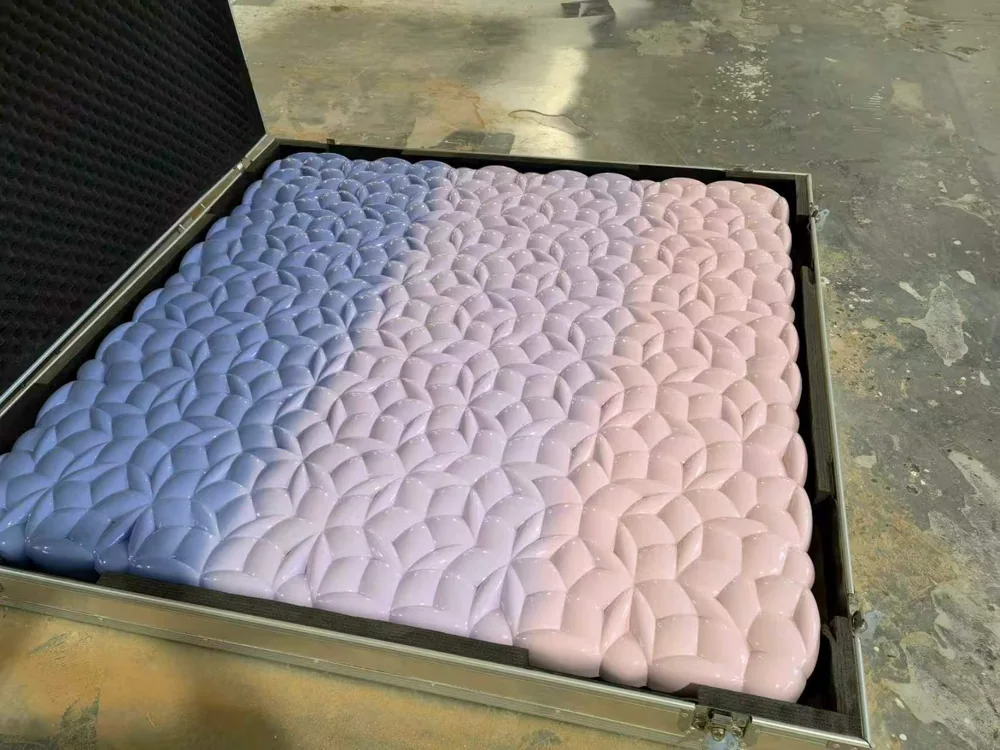
Each section gets its own case. The piece shown here sits in a foam-lined travel case cut to its shape, so it cannot move inside. Foam supports the form at its fragile points and takes the knock if the case is handled roughly.
The steps are simple but careful:
1. Wrap. The surface is wrapped to protect the paint from contact with foam and straps. 2. Foam. Cut foam is fitted around the sculpture, supporting thin edges and raised detail. 3. Case. A framed case is built to the outside dimensions of the packed piece. 4. Check. We move the case and listen for anything loose. Nothing should shift. 5. Crate. For export, cases are placed in a crate with documents fixed to the outside.
Protecting the finish
A painted surface is the most vulnerable part. A gradient or a multi-colour finish is masked and sprayed in stages, and each colour needs the same care in transit. Wrapping materials are chosen so they do not mark the coating, and straps never cross a painted face.
Outdoor work has a UV-resistant gel coat under the paint, which also helps the surface stand up to handling. Our note on colour matching outdoors explains the coating schedule.
Export documents and freight
Shipping from Shanghai, we prepare the crate, the packing list and the customs documents. Freight is quoted by destination, because air and sea costs differ widely, and import duties depend on the country. We give you an estimated arrival date with the quote and confirm it once the booking is made.
For an exhibition deadline, allow extra time at the port. Sea freight is cheaper and can take several weeks. Air freight is faster and costs more. If the date is tight, ask us to price both.
Assembly on arrival
Sections are numbered and packed in the order they will be joined. We include a simple assembly guide with matching points marked on the pieces. For larger installations, we can send a technician to assemble and blend the joins on site; this is quoted separately and depends on the destination.
If the piece will be mounted, tell us the fixing method before it ships. We can build mounting points into the structure while the sculpture is still in the studio, which is far cleaner than drilling it later.
What affects the shipping cost
Three things: volume, weight and distance. A tall piece with a large base wastes space in a crate, so the shape of the packing matters as much as the sculpture. Freight companies charge by volume as well as weight. Where the work is delivered also matters — a city centre with restricted access may need a smaller vehicle and a hand crew.
Planning a delivery
Send the target address, the access situation and your deadline with your enquiry. We will tell you how the piece should be divided, what the packing will involve, and what delivery will cost. See how a custom sculpture is priced for the full budget picture, or how long a fiberglass sculpture takes for timing. To discuss a shipment, use the enquiry form.